
I’m usually slow on the uptake of popular media but nonetheless I kept an eye out for discussion on Netflix’s The Queen’s Gambit as I was primary/high school chess champion, and have had my share of chess coaching back then (this was around the early days of Chess Kids, which is pretty much a brand name here around here in Victoria).
My Chess History
I don’t remember what age I started playing chess (definitely between 5-10 years old), but my dad had a chessboard and taught me how to play (after that he also taught me Chinese chess, but I didn’t take to it as well). My dad knew the moves and basic strategy, so as I grew up it was a relatively classic “Dad kept beating me and then I gradually got better and better and started beating him.”

In primary school I had chess coaching as an after-school activity and would regularly represent the school in inter-school chess competitions, where I amusingly recall a notorious school who consistently had a strong chess team that regularly that consistently took #1 and played in State competitions. Their #1 player at the time (I still remember his name!) had a rating of 1400-1500, and my rating was around 1000. Yet I was still consistently one of the top players of my primary school.
My interest started dwindling when games became predictable and boring for me because I had the core basics down pat and every game ended up looking like some variation of the Four Knights Game:

Yet I didn’t know how to break out of it, nor was confident in trying alternative (i.e. Queen Pawn) openings. I briefly entered an inter-school competition in Year 8, and then chess had a bit of an upsurge in popularity where people would play it during lunch, then in Year 11-12 people would be playing in the student common rooms. However once I started playing and beating people, word got around and as a result people didn’t want to play me, which was disappointing.
No doubt that now, at 31 years old I’m lucky to be able to just casually play and explore chess on my own time and pick up where I left off. I still have no intention of seriously studying like I did before, but given the anonymity and the sheer availability of the internet I’m enjoying playing around with alternative openings and I’d like to be able to occasionally play games with trusted friends every now and then.
Anyway, nostalgia?
There are many aspects of my early chess experience that I fondly remember, that just came rushing back to me while watching The Queen’s Gambit. A warning that there will be some mild spoilers from here onwards, but not of the overall story nor crucial plot points.
Ambiance of a chess game between two players
I’m searching through my memories of a non-chess situation where two people would sit down together intensely concentrated on a single area and…I’m falling short. In a way it’s like you and your opponent encased in a single state of flow, guided along by the soft ticking of the analog chess clocks, and occasionally punctuated by the tapping and clinking of chess pieces with the table (or with each other).
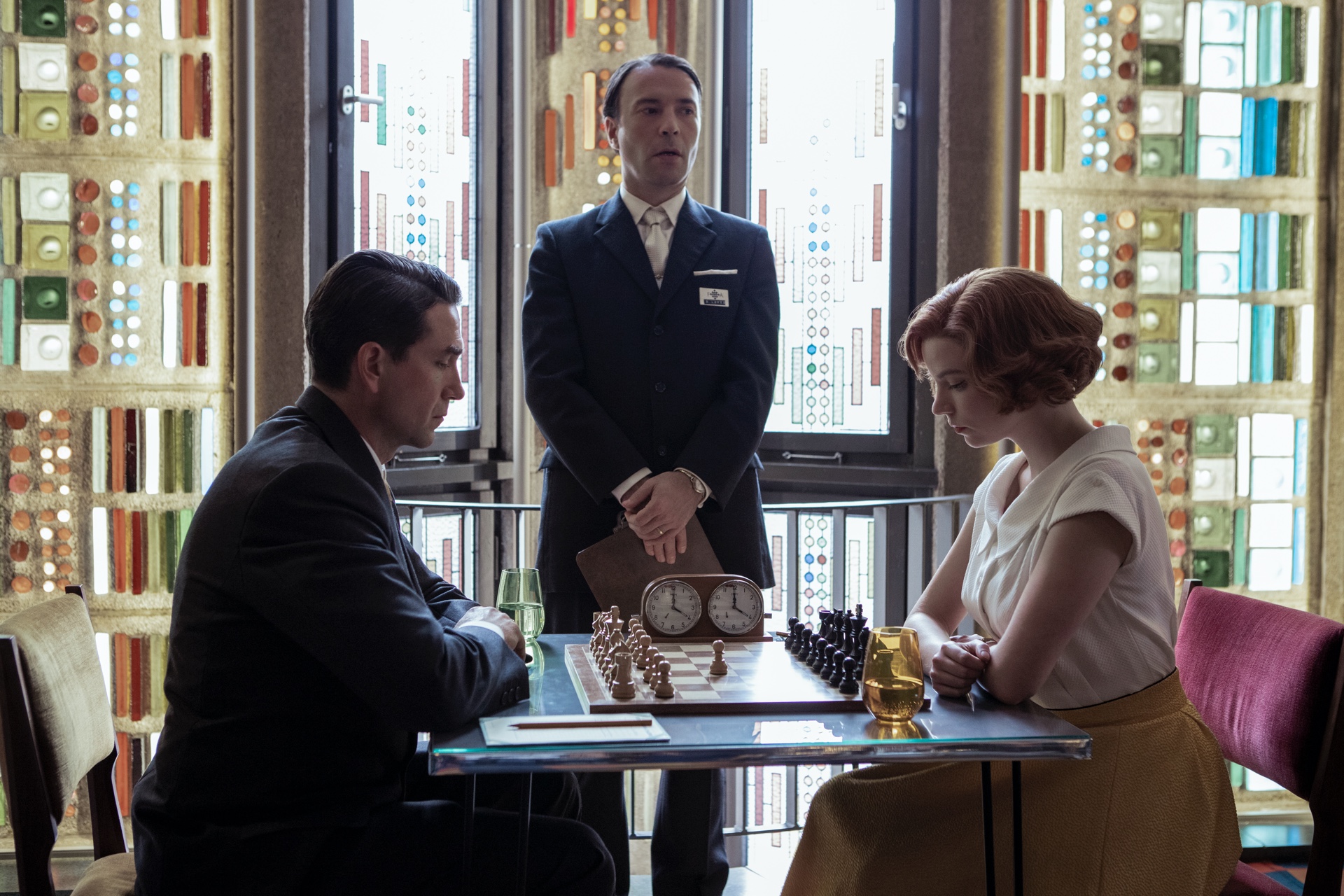
One of the things I loved was that due to this kind of environment it’s very easy to pick up on your opponent’s bad habits: bad breath, ugly teeth, a tic. However the environment also meant that either player could have a chance to intimidate the other in various ways.
Chess clocks
Obviously now we don’t see them just in chess, but in other games like Scrabble where there’s some element of timed competition between two players. The analog clocks, however, always had a soft and steady tick-tock that added to the ambiance of the game, and given their obvious lack of visual accuracy it was always amusing to keep a sharp eye on the flag and hoping it’d drop soon enough, since we didn’t have the convenience of a seconds hand to keep close track of the actual time. There’s no doubt that digital clocks now are much better and solve the problems that analog clocks have.

Ambiance of a chess tournament
People around my age and older will definitely remember arcades (TimeZone, Timeout), and how after school and on the weekends people would flock there to have a go at the games, collect tickets and exchange them for prizes. Occasionally there’ll be someone showing off some flashy moves on the latest Dance Dance Revolution/Into The Groove, which would then draw a crowd of people watching. It’s not a stretch to say the ambiance is similar to that of people crowding around to watch a chess game, especially when powerful and renowned players are battling it out.
It is a very weird experience as a player at first, but then one learns to properly concentrate on the game and block out their surroundings. However for observers of the physical game it’s common sense to not actively discuss the game while it’s being played, and you certainly don’t want to make noise such that the players’ concentration is interrupted. The resulting ‘quiet but buzzing’ ambiance is an experience that The Queen’s Gambit really portrays very well in their cinematography.
Chess game discussions
In a similar way that people nerd out over a shared interest, The Queens Gambit gives a little insight into what it’s like to nerd out over chess games, especially with the appropriate terminology, names, and references. I like to think they did a good enough effort of easing non-chess players into that kind of world but completely understand if they felt a little alienated as a result.
Comments & Criticisms
Warning: Major spoiler territory onwards!
Despite the very faithful representation of the ‘chess world’, there are definitely a few things that didn’t necessarily sour the full series, but certainly struck me as odd. I should make clear however that I haven’t read the original story that this TV mini-series was based on, so perhaps some of the things I’m critical of were purely because it was described that way in the book.
Casting
The one casting choice that struck me as odd purely in terms of appearance was Thomas Brodie-Sangster as Benny Watts. Unfortunately Thomas still has somewhat of a ‘baby face’ of which his moustache didn’t really help obscure. While it’s not stated anywhere what age Benny Watts is meant to be, it was tough to guess whether he was meant to be slightly older than Beth Harmon or not.
On a more positive note, I knew I’d recognised Harry Melling (playing Harry Beltik) somewhere but was pleasantly surprised to find that he’s the now grown-up Dudley Dursley from the Harry Potter movies!
Dialogue
Like every niche sport or hobby the community within usually ends up developing their own ‘language’ and the majority of conversations held within said community are all pretty faithful to what I’ve experienced. However there were a few odd lines said by Benny Watts where he was talking about openings (Caro-Kann, among others) which…I can’t quite imagine actually ever hearing or happening, and as a result, stuck out like a sore thumb for me.
One bit I particularly enjoyed was Beth describing chess games to her mother (despite said mother not knowing anything about the game) where it can play out like a story. It’s very similar to when people are able to talk about concepts in a high level
Faithfulness to the Chess Environment
There’s a lot I can gush about about how they utterly nailed the environments back then, from the setting all the way down to the individual moves. However instead of unnecessarily writing more, I’ll leave you with two articles/interviews of the chess consultants (one being the former world champion Garry Kasparov) that played a large part in the mini-series.
- World Chess Champion Garry Kasparov on What “The Queen’s Gambit” Gets Right.
- Best of 2020 (Behind the Scenes): How The Queen’s Gambit changed the game for chess on screen.
The rise of interest in chess as a result of this mini-series is no doubt a testament to how accessible the game was viewed by people of all walks, and while there’ll definitely be some dropoff once the initial interest dies off, it’ll no doubt be a monumental piece in chess history that helped spurn interest in a game full of intricate strategies.
Recently as part of a maths conference I took part in a chess tournament, and got out of the group stages, but lost in my first knockout round. No doubt that we’d have some quality chess players within a sizable population of mathematicians!
I’ll admit that I don’t have any desire to play chess seriously/competitively anytime soon, as I personally find it very stressful when I take a game seriously – my brain mentally wants to go 100% all in. However, like maths, I’ve learnt to find fun in the intellectual exercise for leisure, although admittedly I’m starting to realise a glass ceiling that looks a little difficult to break through!
Be First to Comment